

If you are considering Invisalign, you probably have questions. It’s a significant decision, and having clear, honest answers is important. At Highland Family Dental Care, Dr. Mana Shoeybi and our team are here to guide you through every step, from your first consultation to your final smile.
This comprehensive FAQ page answers the most common and not-so-common questions about Invisalign. We want you to feel fully informed and confident in your decision to pursue a straighter, healthier smile.
The Invisalign Process
What is Invisalign and how does it work?
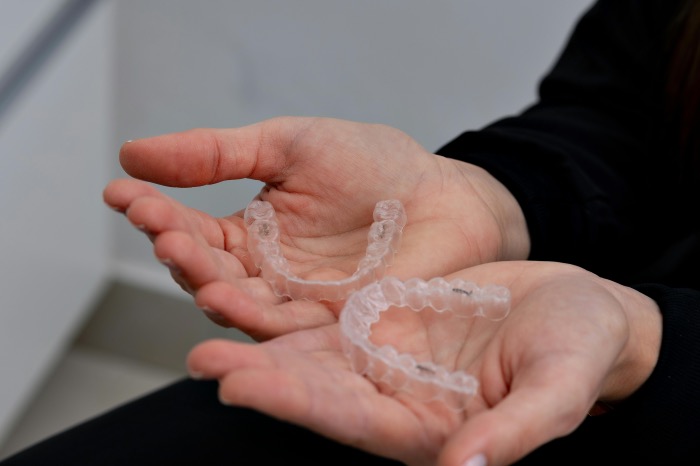
Invisalign is a modern orthodontic treatment that uses a series of clear, custom-made aligners to gradually straighten your teeth. Unlike traditional braces, Invisalign uses no brackets or wires. Instead, you wear a set of aligners for about two weeks. Each set applies gentle pressure to specific teeth, moving them incrementally into the desired position over the course of your treatment.
What happens during the initial consultation?
Your journey begins with a comprehensive consultation with Dr. Shoeybi. She will evaluate your oral health and discuss your smile goals. Using advanced technology, we will take digital scans and X-rays of your teeth to create a precise 3D model. This model is used to design a detailed, personalized treatment plan that maps out your entire smile transformation before you even start.
How long does the Invisalign process typically take from start to finish?
The length of treatment varies depending on the complexity of your case. For many adults, treatment ranges from 6 to 15 months. However, some cases may take longer. Patients who don’t need significant bite correction may have shorter treatment times, while more complex cases may require more time.
What are “refinements,” and why might I need them?
Refinements are additional aligners used at the end of your initial treatment to fine-tune the final position of your teeth. They are often factored into the estimated treatment time. While reaching the end of your initial set of trays is exciting, many patients need refinements to achieve ideal results. This is a normal part of the process and ensures your smile is both straight and stable.
How do I know if I’m a good candidate for Invisalign?
Invisalign is highly versatile and can treat a wide range of orthodontic issues, including crooked teeth, gaps, overbites, underbites, crossbites, and crowded teeth. The best way to determine your candidacy is to schedule a consultation with Dr. Shoeybi. She will assess your specific needs and confirm if Invisalign is the right treatment for you.
The Patient Experience
Does Invisalign hurt?
You may experience some mild soreness or pressure when you first start a new set of aligners. This is a good sign that the aligners are working to move your teeth and typically fades within a few days. Many patients describe this initial sensitivity as a dull ache or pressure rather than sharp pain, and it’s usually manageable with over-the-counter pain relievers.
What are the “attachments” or “buttons,” and will I have them?
Attachments are small, tooth-colored bumps that are bonded to your teeth to help the aligners grip more effectively. They allow for more complex and precise tooth movements. While they are designed to blend in, they can make your aligners slightly more noticeable. However, they are critical for achieving optimal results and are far less visible than traditional braces.
Will Invisalign affect my speech?
You may notice a slight change in your speech when you first start wearing aligners. This is most common with “s,” “sh,” or “z” sounds. This is a temporary adjustment as your mouth and tongue get used to the aligners. Practicing speaking, reading aloud, or singing can help you adapt more quickly. Any lisp or change in speech typically resolves within a few days to a week.
What should I do if I lose or break an aligner?
If you lose or break an aligner, contact our office immediately. Don’t try to fix it yourself or skip to the next set in your series. Dr. Shoeybi will advise you on the best course of action. Depending on your situation, we may recommend wearing the previous set of aligners or ordering a replacement, which can temporarily pause your treatment.
Is Invisalign really invisible?
While Invisalign is significantly less noticeable than traditional braces, it’s not completely invisible, especially if you have attachments. However, the aligners are made of a clear, smooth plastic that is discreet and barely noticeable from a distance. Many patients find the trade-off for a more comfortable and flexible treatment well worth it.